


Campground maps, welcome guides, parking passes, and other printed materials may seem like relatively small operating expenses when considered individually. But printing is rarely a one-time cost. Materials need to be designed, ordered, stored, distributed, and eventually reprinted when supplies run low or information changes.
That makes the cost of paper guides vs digital guides worth examining as part of a campground’s annual budget. Digital guides won’t eliminate every communication expense, but they can reduce dependence on recurring print runs while giving guests access to information that can be updated without replacing an entire batch of materials.
The right choice doesn’t have to be completely paper or completely digital. For many campgrounds, the more useful question is which materials genuinely need to be printed and which recurring costs could be reduced by moving guest information online.
What Do Paper Campground Guides Really Cost?
When comparing printed and digital options, looking only at the price per printed map can underestimate the true cost. Campgrounds should consider the full process of creating, maintaining, and distributing printed guest materials throughout the year.
Design and Preparation
Before a campground map or guest guide reaches the printer, someone has to prepare the content and layout. Updates to rates, amenities, policies, site information, local businesses, or campground features may also require design changes before the next batch can be ordered.
Printing Costs
Printing costs for campgrounds depend on factors such as quantity, size, paper stock, color, finishing, and the printing company used. A large order may lower the cost per piece, but it also means committing money to materials that need to remain accurate until the entire supply is distributed.
Reprinting When Information Changes
Printed materials become harder to use when information changes before the supply runs out. A new amenity, updated policy, changed phone number, or revised local recommendation can leave a campground choosing between distributing outdated information and paying for an updated print run.
Shipping and Storage
Physical materials also have to reach the campground and be stored until they’re needed. Depending on the printer and order size, freight or shipping and the space required for boxes of maps, guides, passes, and other materials can become part of the overall expense.
Staff Time and Distribution
Printing also involves labor that can be easy to overlook when calculating costs. Staff may spend time reviewing proofs, coordinating orders, organizing supplies, handing materials to arriving guests, and managing replacements or updated versions. Mathematical Sciences Publishers similarly recommends including labor when calculating the cost of print publishing rather than considering only the printer’s charge.
Unused and Outdated Materials
Ordering extra copies can prevent a campground from running out during a busy season, but those extras carry some risk. If information changes before they’re distributed, leftover guides may no longer be useful, meaning part of the original printing investment is wasted along with the physical materials themselves.
What Do Digital Campground Guides Really Cost?
Digital guides have a different cost structure than printed materials. Instead of focusing on the cost per physical copy, campgrounds need to consider the platform itself, ongoing management, and which existing expenses the digital guide may reduce or replace.
Platform and Subscription Costs
Some digital guide platforms charge setup fees, monthly subscriptions, annual fees, or other technology costs. When comparing options, campgrounds should calculate the full annual expense rather than assuming that every digital solution is automatically cheaper than print.
Updates Without Reprinting
One of the biggest potential sources of digital guide savings is the ability to change information without ordering another batch of materials. Hours, policies, amenities, local recommendations, and other details can be updated digitally instead of leaving the campground with outdated printed guides.
Less Physical Inventory to Manage
Digital information doesn’t require boxes of guides to be ordered and stored for the season. Campgrounds can reduce the need to estimate quantities in advance and avoid having excess materials left over when information changes.
Reduced Printing and Paper Waste
Moving frequently changing information online can reduce the number of maps and guides that need to be printed each year. Paperless campground guides can also help reduce paper waste at a campground, particularly when printed materials would otherwise be discarded because they’re outdated.
One Place for Multiple Guest Resources
A digital area guide platform can bring maps, campground information, local recommendations, and other guest resources into one digital destination. This may reduce the need to produce several separate pieces of printed material for every arrival.
Digital Doesn’t Have to Mean No Paper
Campgrounds don’t necessarily need to eliminate printed materials altogether. As our comparison of digital guides vs. printed guides shows, a hybrid approach can keep physical maps available for guests who want them while moving information that changes frequently to digital channels.
Compare the Cost of Paper Guides vs. Digital Guides
The most useful comparison isn’t simply the price of printing versus the price of a digital platform. Campgrounds should look at everything they spend over a full year to create, update, distribute, and maintain guest information.
A simple annual comparison might include:
| Cost to Compare | Paper Guides | Digital Guides |
|---|---|---|
| Initial Setup | Design and print preparation | Platform setup and digital content |
| Recurring Costs | New print runs as supplies run low | Subscription or platform fees, if applicable |
| Information Updates | May require redesign or reprinting | Can typically be updated digitally |
| Distribution | Physical copies given to guests | Guests access information digitally |
| Storage | Space needed for printed inventory | No physical guide inventory |
| Outdated Materials | Unused copies may need to be discarded | Information can be revised without replacing physical copies |
| Staff Time | Ordering, organizing, and distributing materials | Updating and maintaining digital information |
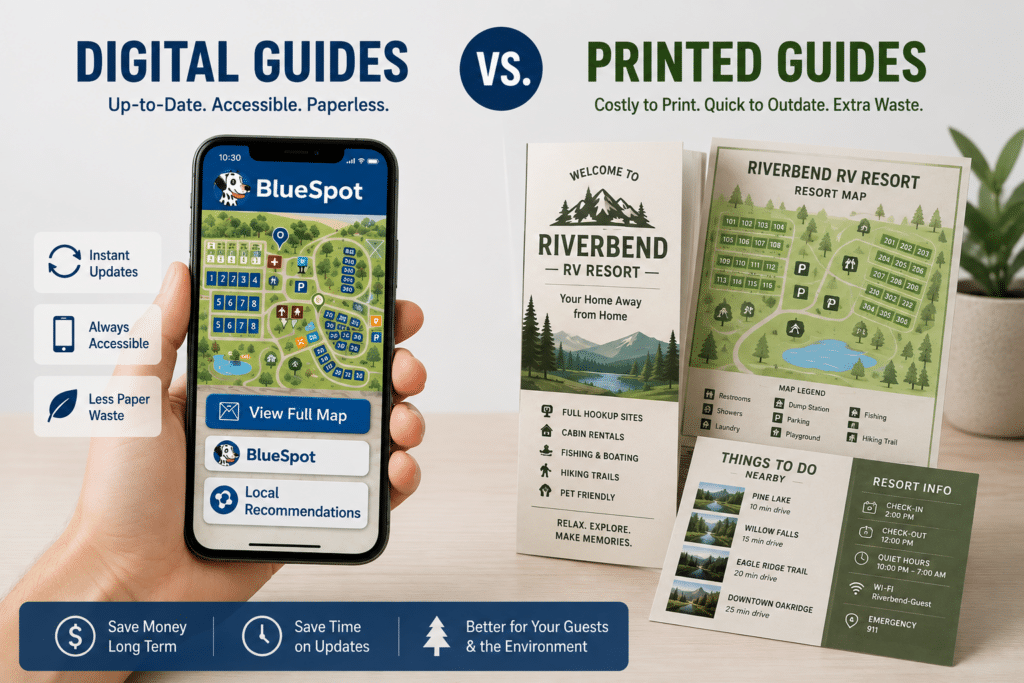
The actual digital guide savings will depend on how much a campground currently prints and what its chosen digital solution costs. A property that regularly purchases campground maps, guest guides, parking materials, and a separate guest app may have more recurring expenses to evaluate than a small campground that prints only a limited number of maps.
Campgrounds should also consider which expenses could be consolidated rather than comparing one printed map with one digital guide. For example, a digital guest resource may combine property information, maps, and local recommendations that were previously delivered through several separate materials.
This doesn’t mean printed maps have no value. Campgrounds can still offer a free campground map when it improves the arrival experience while using digital resources for information that changes more frequently.
Ultimately, the best way to understand the cost of paper guides vs digital guides is to total what your campground spent on guest-information tools during the previous 12 months. Include printing, design changes, shipping, reprints, unused materials, app or platform fees, and staff time to get a more realistic picture of where savings may be possible.
Frequently Asked Questions
Are digital campground guides cheaper than printed guides?
They can be, particularly for campgrounds that regularly print and update large quantities of guest materials. However, savings depend on current printing expenses and any setup, subscription, or maintenance costs associated with the digital platform.
Can a campground completely replace printed guides with digital guides?
It can, but a fully paperless approach isn’t necessary for every property. Some campgrounds may benefit from keeping physical maps available while using digital guides for information that changes frequently.
How can digital guides reduce campground printing costs?
Digital guides allow information to be accessed repeatedly without printing another copy for every guest. They can also reduce reprinting when hours, policies, amenities, maps, or local recommendations change.
Are digital guides more sustainable than paper guides?
Reducing unnecessary printing and discarded outdated materials can help decrease paper use and waste. The broader environmental comparison depends on factors such as printing practices, materials, devices, hosting, and how each system is used.
Look Beyond the Cost of the Next Print Run
The real opportunity isn’t simply replacing paper with a screen. It’s identifying how much your campground spends every year keeping guests informed and determining whether some of those recurring expenses can be reduced or handled differently.
Before budgeting for another round of maps, parking materials, printed guest information, or separate technology tools, compare what those resources cost your property over an entire year. BlueSpot Connect provides campground guest solutions that can help properties rethink how maps, guest information, and digital resources are delivered.
Explore BlueSpot Connect’s digital area guide platform and see where your campground may be able to reduce recurring guest-information costs.