


Introduction
In hospitality, guest satisfaction often depends on one simple factor: clarity.
Guests want to know where to go, what to do, and how to access amenities without confusion. Traditionally, properties relied on printed binders, paper brochures, and verbal instructions. Today, guest expectations have shifted. Travelers expect instant, mobile-friendly access to information.
Digital area guides meet this expectation while improving operational efficiency.
At BlueSpot Connect, digital area guides are designed to work seamlessly on-site through scannable iConnectTags and iConnectMaps. Guests do not need to download an app. They simply scan and access a centralized Guest Hub directly in their phone’s browser.
This approach supports both guest experience and property management goals.
Understanding Digital Guest Experience in Campgrounds and RV Parks

Defining Digital Area Guides and Their Evolution
A digital area guide is a web-based resource that provides guests with:
- Area Events
- Area Attractions
- Interactive maps
- Nearby dining, shopping and attractions
- Local service providers
- Local Weather
In the past, this information lived in printed booklets. Today, digital guides are dynamic, searchable, and accessible from anywhere on the property.
Government agencies have long emphasized clear wayfinding and accessible public information. The U.S. General Services Administration (GSA) highlights the importance of digital accessibility standards for public-facing information systems:
Similarly, the U.S. National Park Service prioritizes clear visitor information systems to improve safety and reduce congestion:
Digital guides apply these same clarity principles within private hospitality environments.
Why Digital Guest Guides Are Transforming Stays
Guests now plan, book, and navigate travel primarily on mobile devices. According to the U.S. Travel Association, digital planning and mobile search have become central to trip decision-making:
Digital area guides transform stays because they:
- Reduce dependency on front desk explanations
- Provide consistent information
- Update instantly when things change
- Enhance the guest experience
BlueSpot Connect bridges physical signage with digital clarity. iConnectTags rearview mirror tags guide your guests with ease, using QR codes to link them to your map, rules, guest app, and local guide at no cost to your part.
Key Benefits of Digital Area Guides for Guests
Personalized Recommendations and Local Insights
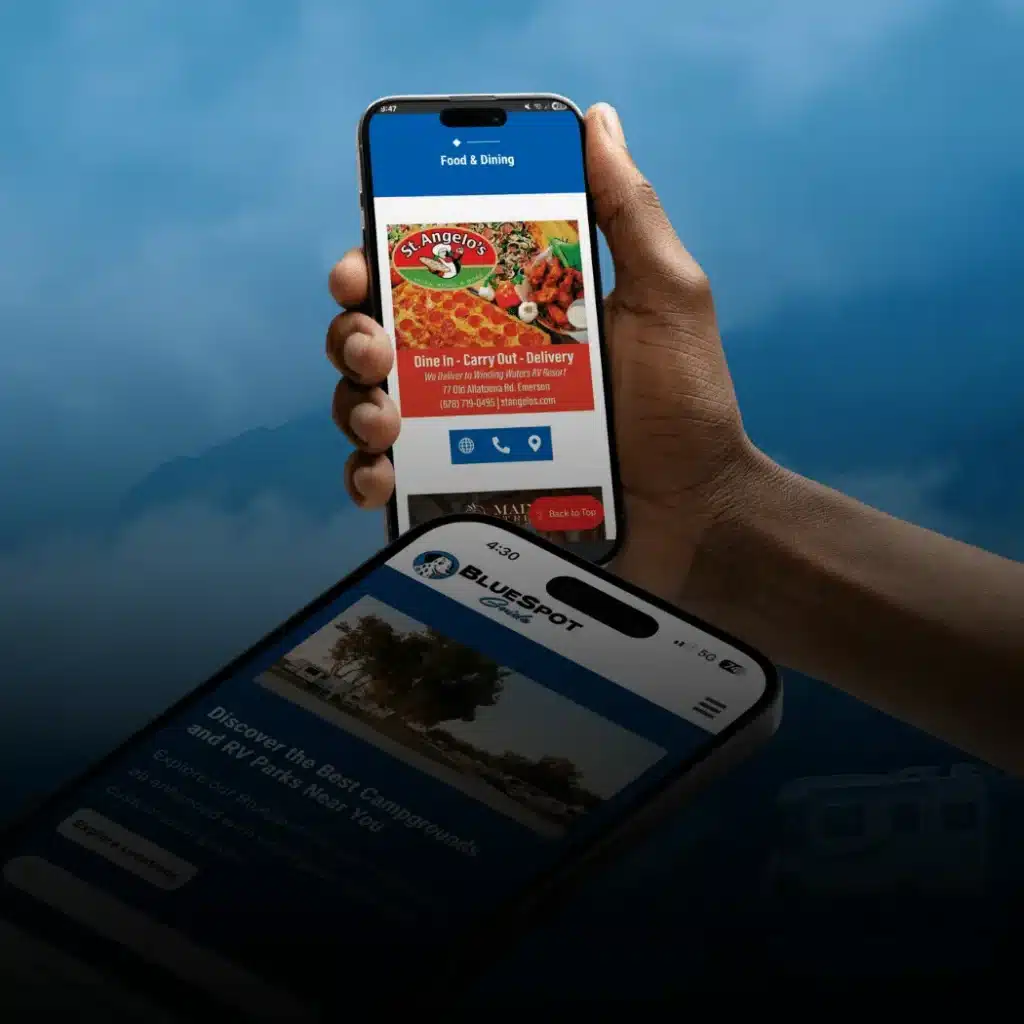
Guests often ask:
- Where can we eat nearby?
- Are there local attractions worth visiting?
- What events are happening this weekend?
A digital area guide can organize recommendations by category:
- Family-friendly restaurants
- Outdoor recreation
- Local shops
- Seasonal festivals
This strengthens local economic connections while helping guests make the most of their stay.
BlueSpot Connect supports curated local discovery through organized digital guide sections that highlight community businesses and attractions without overwhelming guests.
Effortless Access to Information Anytime, Anywhere
One of the greatest benefits of digital guides is immediate accessibility.
Guests can:
- Access property rules at 10 PM without visiting the office
- Check pool hours while walking toward the amenity
- Review site maps from their RV
- Confirm quiet hours instantly
Because BlueSpot Connect’s Guest Hub operates through the mobile browser, there is no download barrier. This reduces friction and improves adoption rates.
Accessibility also aligns with federal digital inclusion standards, such as Section 508 compliance guidance:
Clear digital communication supports broader accessibility goals for all users.
Essential Features to Include in a Digital Guest Guide
Interactive Maps, Local Attractions, and Dining Options
An effective digital guest guide should include:
- Property maps with labelled amenities
- Directions to restrooms, laundry, and dump stations
- Nearby restaurants and grocery stores
- Outdoor attractions and trail access
Clear wayfinding reduces confusion and improves the overall guest experience.
BlueSpot Connect enhances this by using rearview mirror tags that guide guests with ease. These tags feature QR codes that link directly to your property map, rules, and local guide at no cost to your property.
Placed directly in guests’ vehicles, rearview mirror tags ensure information is always accessible. Guests can scan at any time to review directions, confirm policies, or explore local recommendations without needing to visit the office.
This simple physical touchpoint connects guests instantly to organized digital information, improving clarity while reducing repetitive questions for staff.
Digital Versus Printed Guest Guides: What Sets Them Apart?
Enhancing Guest Convenience and Satisfaction
Printed guides have served hospitality for years, but they come with limitations:
Printed guides:
- Can become outdated quickly
- Are easy to misplace inside RVs or cabins
- Require reprinting when policies or local listings change
- Do not allow real-time updates
In contrast, BlueSpot Connect’s digital approach is built for clarity and flexibility.
Digital guides:
- Update instantly across all access points
- Remain accessible on the guest’s phone
- Provide organized, mobile-friendly navigation
- Reduce repetitive “Where is…” and “What time…” questions
The difference is not about replacing hospitality. It is about strengthening communication clarity.
With BlueSpot Connect, digital information is connected directly to physical touchpoints on the property. IConnect is a rearview mirror tags guide guests with ease using QR codes that link them to your map, rules, guest app, and local guide at no cost to your property.
Guests scan once and access everything in one centralized Guest Hub. No downloads. No searching across multiple platforms.
When guests can find information independently, satisfaction improves and staff workload decreases.
Sustainability, Cost Efficiency, and Real-World Examples
Reducing printed materials supports broader sustainability efforts.
The U.S. Environmental Protection Agency (EPA) encourages waste reduction strategies, including minimizing printed materials where practical:
Digital area guides reduce paper waste while maintaining accessibility. Instead of reprinting seasonal booklets, updating laminated maps, or replacing outdated local listings, properties can make instant adjustments inside their digital guide.
From a cost standpoint, recurring print runs add operational expense. Policy updates, new attractions, or seasonal rule changes require new materials. A centralized digital guide eliminates those repeat costs while providing greater flexibility.
BlueSpot Connect’s approach is intentionally hybrid. Physical visibility remains strong through iConnect tags, iConnect maps, iConnect taps, while the information itself lives in a structured, web-based Guest Hub.
This preserves guest awareness while eliminating unnecessary printing.
Clear communication.
Lower friction.
Smarter operations.
Conclusion
Digital area guides are more than a technology trend. They are a practical guest value add.
They improve clarity.
They reduce operational strain.
They strengthen local partnerships.
They support sustainability.
BlueSpot Connect designs digital guest communication systems that are simple, accessible, and aligned with real-world hospitality workflows.
Through iConnectTags, iConnectMaps, iConnect taps, and centralized web-based Guest Hubs, properties can provide instant access to information without requiring downloads or complex systems.
Clear information builds confidence.
Confidence builds better stays.
Frequently Asked Questions
Digital guides reduce repetitive questions, minimize front desk interruptions, and allow staff to focus on service instead of directions. Real-time updates eliminate the need to reprint materials or manually notify guests of changes.
The process typically includes:
Organizing property policies and amenity details
Adding local attraction recommendations
Creating interactive maps
Structuring the guide for mobile access
Linking access points through scannable tags
BlueSpot Connect simplifies this by centralizing guide content into a web-based Guest Hub and connecting it to on-site physical touchpoints.
Common challenges include:
Overcomplicated systems
Low guest adoption due to app downloads
Poor mobile usability
Inconsistent information updates
BlueSpot Connect addresses these challenges by removing download barriers, simplifying access through QR-based touchpoints, and maintaining a centralized structure that keeps information consistent across the property.