


Introduction
Whether you are a traveler pulling into a campground after a long drive or a campground or RV park owner preparing for another busy season, the first few minutes on property matter.
For travelers, those first moments shape the entire stay. Clear directions, easy access to rules, and confidence about where to go next reduce stress immediately.
For campground and RV park owners, those same moments determine whether staff spend their time welcoming guests or answering the same questions repeatedly.
Across the United States, outdoor recreation agencies have been emphasizing this balance for years. The National Park Service and the U.S. Forest Service both highlight that visitor safety, satisfaction, and operational efficiency depend on clear information and well-planned wayfinding.
Planning digital improvements early for 2026 is not about adding technology for its own sake. It is about helping travelers feel oriented and helping operators run smoother, calmer properties.
Why Digital Planning Matters to Travelers and Owners Alike
What Travelers Want When They Arrive
Travelers especially families, first-time campers, and RV guests are not looking for apps or complicated systems. They want quick answers:
- Where is my site?
- What are the quiet hours?
- How do I find showers, laundry, or dump stations?
- What’s nearby if we want to explore?
Research referenced by the National Park Service shows that confusion and lack of information are among the most common sources of visitor frustration and safety incidents. This applies to public parks and private campgrounds alike.
What Owners Need During Peak Season
For owners and operators, peak season brings predictable pressure:
- High check-in volume
- Limited staffing
- Repetitive guest questions
- Safety and compliance responsibilities
According to labor data from the U.S. Bureau of Labor Statistics, staffing challenges in hospitality and recreation are not short-term trends. Digital guest communication helps support staff not replace them by improving access to information.
What “Digital Improvements” Really Mean in Outdoor Hospitality
Designed without apps, unnecessary automation, or staff replacement.
One of the biggest misconceptions among both travelers and owners is that digital improvements mean apps, automation, or reduced human interaction.
Government accessibility and usability guidance, including recommendations from the U.S. Access Board, consistently favors:
- Simplicity
- No barriers to access
- Clear, consistent information
For travelers, this means no downloads and no learning curve.
For owners, it means fewer disruptions and more consistent messaging.
Physical Spaces Still Matter
Federal transportation and recreation agencies such as the Federal Highway Administration emphasize that physical signage and wayfinding remain essential in shared-use environments.
Digital planning works best when it supports physical spaces maps, signs, and welcome areas rather than replacing them.
How Modern Guest Communication Supports Both Guests and Operators
Clear, easy access to information improves the guest experience while reducing daily friction for campground owners and staff. A modern communication system works best when it meets guests where they already are and keeps information consistent across every touchpoint.
iConnectTags: Smart Vehicle Tags at Check-In
iConnectTags are rearview mirror vehicle tags provided to guests at check-in. Each tag includes QR codes that link directly to the campground’s no-download Guest Hub and Digital Area Guide.
For guests:
- Scan with a phone camera
- No app store or downloads
- Quick access to stay details like maps, rules, Wi-Fi, amenities, and local recommendations
For owners and staff:
- Fewer printed handouts at the front desk
- One place to update guest information
- Less time spent answering the same questions throughout the day
Because the tag stays with the guest’s vehicle, information is always close at hand during their stay.

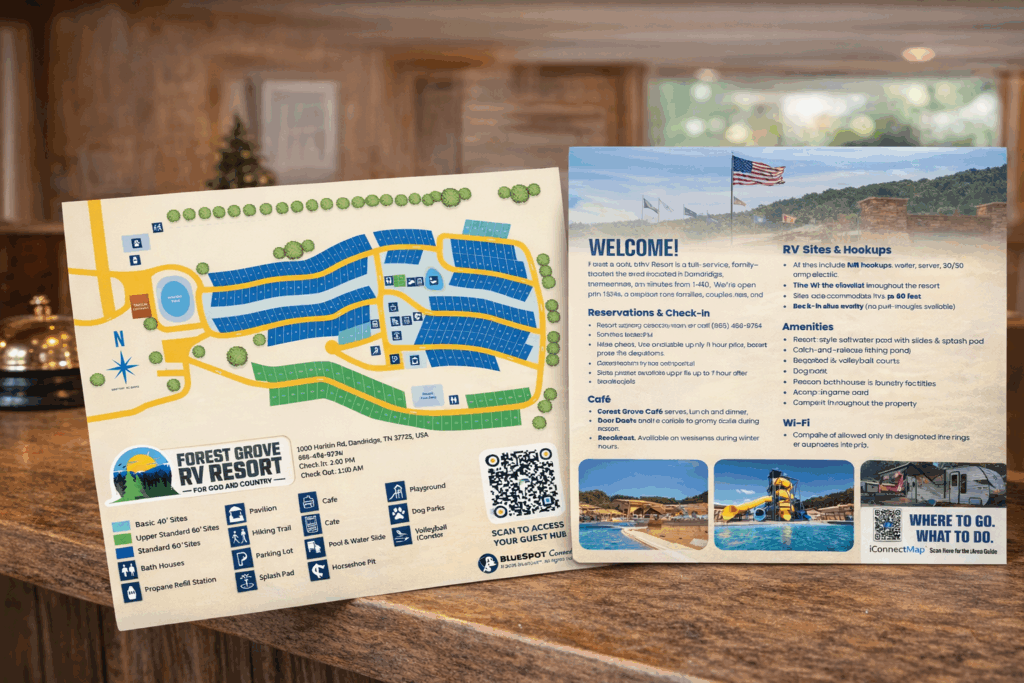
iConnectMaps: Printed Maps with Digital Backup
iConnectMaps are printed campground maps handed out at check-in that include QR codes linking to the same Guest Hub and Digital Area Guide.
For guests:
- A physical map they can easily reference
- Clear layout of sites, roads, and amenities
- The option to scan for more details or updates
For owners and staff:
- Printed maps that don’t immediately become outdated
- Fewer reprints when information changes
- A reliable way to share important updates, including safety or operational notices
This approach combines the familiarity of printed maps with the flexibility of digital content.
iConnectTaps: Quick Access at Key Locations
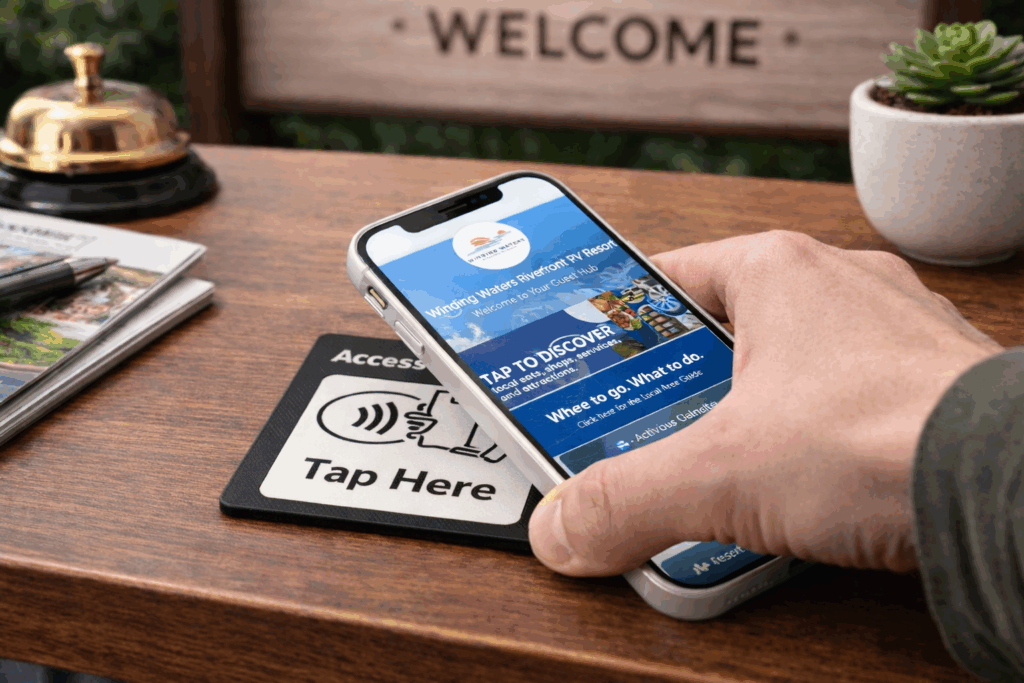
iConnectTaps are NFC tap points placed at locations such as the front desk, welcome boards, or mounted outside the office for after-hours arrivals.
For guests:
- Instant access by tapping their phone
- Helpful for late check-ins or quick info needs
For owners and staff:
- Reduced congestion at check-in
- Faster guest orientation
- Consistent access to essential information without additional staff time
One Central Guest Experience
Whether guests scan an iConnectTag, scan a QR code on an iConnectMap, or tap an iConnectTap, they are taken to the same centralized Guest Hub and Digital Area Guide.
This single source of information keeps communication consistent, easy to manage, and accessible throughout a guest’s stay benefiting both travelers and campground operators.
Why Planning Early for 2026 Makes Life Easier
For Travelers: Familiar, Predictable Experiences
When systems are planned early and used consistently:
- Guests know what to expect
- First-time campers feel more confident
- Repeat visitors recognize familiar access points
Consistency builds trust.
For Owners: Less Stress, Better Flow
Early planning allows owners to:
- Test placement of signage and access points
- Train staff without pressure
- Adjust before peak season
Public agencies routinely plan visitor communication improvements years in advance to avoid operational disruption. Private properties benefit from the same approach.
Clear Information Reduces Risk
Both the National Park Service and U.S. Forest Service document that unclear rules and missing information increase safety incidents.
Centralized Guest Hubs help:
- Clearly display rules and quiet hours
- Share emergency contacts
- Communicate weather or facility updates
Accessibility Supports All Guests
Digital Guest Hubs allow:
- Adjustable text sizes
- Screen reader compatibility
- Consistent access across devices
These features align with accessibility guidance from federal agencies and benefit travelers of all ages and abilities.
Planning Digital Improvements Without Overcomplicating Things
Start with Guest Questions
The best digital planning starts by asking:
- What do guests ask most often?
- Where do they get confused?
- When do staff get interrupted the most?
Answering those questions first keeps systems simple and effective.
Build for Campgrounds and RV Parks of Any Size
Whether you operate:
- A seasonal campground
- A year-round RV park
- A multi-property portfolio
Early digital planning helps create systems that scale naturally without forcing major changes later.
Frequently Asked Questions
No. The Guest Hub is web-based and requires no app store download.
No. They support staff by reducing repetitive questions and improving access to information.
Yes. Scanning and tapping are widely used and require minimal instruction.
No. Early planning reduces cost, stress, and disruption for both guests and operators.
Conclusion
Planning digital improvements early for 2026 benefits everyone involved in outdoor hospitality.
Travelers arrive more confident, less stressed, and better informed.
Campground and RV park owners gain calmer operations, supported staff, and clearer communication.
By thoughtfully connecting printed materials, scannable QR tags, NFC tap points, and a centralized, no-download Guest Hub, properties can meet rising expectations without adding complexity.
Want to learn more or request free iConnectTags for your property? Visit BlueSpot Connect to contact and get started.